

How to Dry a Dog After a Bath: Calm, Coat-Safe Steps
Table of Contents
- Why Drying Your Dog Properly Matters
- What You'll Need: A Simple Drying Checklist
- How to Towel Dry a Dog Without Tangling the Coat
- How to Blow Dry a Dog at Home (Safely)
- Can Dogs Air Dry After a Bath?
- How Long Does It Take for a Dog to Dry After a Bath?
- Drying Tips for Different Coat Types
- Common Drying Mistakes to Avoid
- Frequently Asked Questions
Last Updated: October 19, 2026
Why Drying Your Dog Properly Matters
Learning how to dry a dog after a bath is about more than keeping your floors dry. A wet coat traps damp against the skin, and that damp can lead to chills, a musty smell, and, in curly or tangle-prone coats, knots that tighten as the fur dries. At Dexter And Billy Co, we hear from owners every week who bathed their dog in good faith and ended up with a matted coat or a shivering pup for their trouble.
The fix is simple: dry with purpose, not just until the worst of the drips stop.
Drying well does three things:
- Keeps your dog warm and comfortable
- Stops damp from sitting against the skin
- Prevents wet fur from clumping into tangles
For curly and fleece coats, that last point matters most. Wet curls cling together, and if they dry that way, the knots set. That is why we treat drying as part of grooming, not an afterthought.
What You'll Need: A Simple Drying Checklist
A good drying setup takes five minutes to prepare and saves you a lot of wrestling. Here is what we would have on hand before your dog leaves the bath.
- Two or three absorbent towels, ideally one with hand pockets for grip
- A hairdryer with a cool or low-heat setting (optional)
- A wide-toothed comb for tangle-prone coats
- A non-slip mat or towel on the floor
- Treats within reach for calm rewards
- A warm, draught-free room to dry in
That is the whole kit. You do not need a professional setup to dry a dog well at home, just a bit of organisation.
How to Towel Dry a Dog Without Tangling the Coat
Towel drying is the first and most important step. It removes most of the surface water, which cuts drying time and reduces the chance of tangles setting.
Here is how we recommend doing it:
- Blot, don't rub. Press the towel against the coat and hold it for a few seconds. Rubbing roughs up the coat and pushes water deeper into curls.
- Work in sections. Start at the back and move along the body, then finish with the legs and paws.
- Use hand pockets if you have them. A towel with pockets gives you a secure grip, so you can wrap and squeeze gently rather than chasing a slippery dog.
- Change towels when soaked. A wet towel stops absorbing, so swap it out.
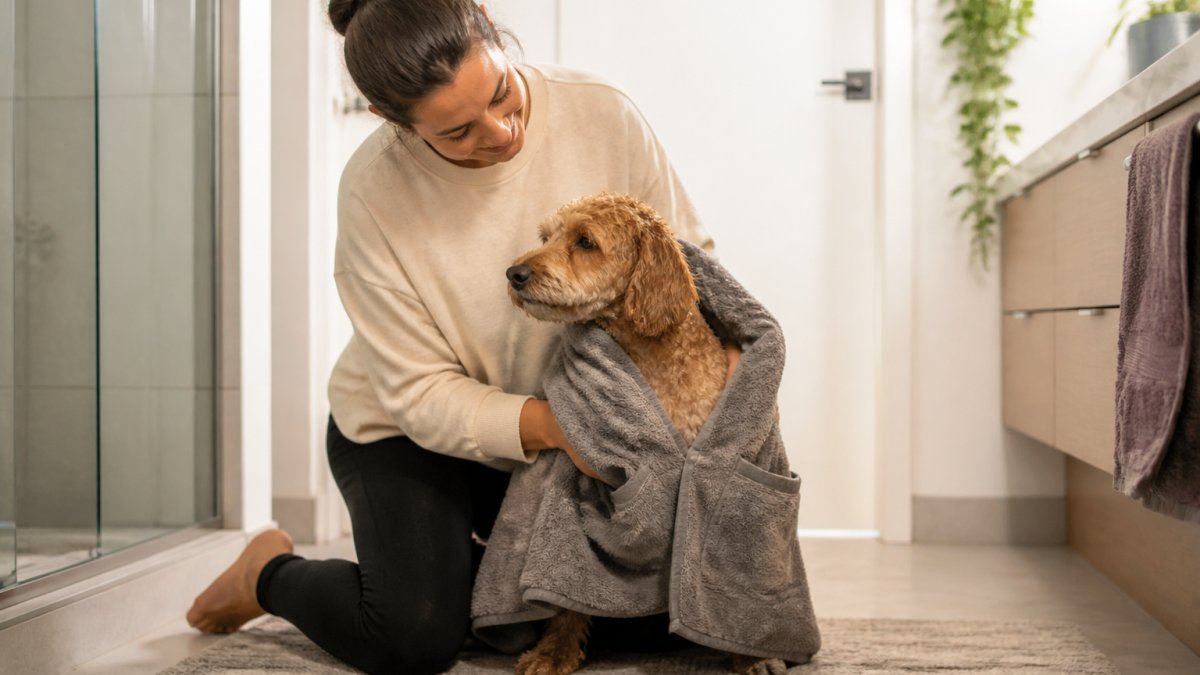
For this step, we reach for Pride + Groom THE TOWEL. It soaks up water up to seven times its own weight, and the hand pockets make it far easier to hold a wriggling dog steady. A quick towel-down with it cuts the drying time that follows.

How to Blow Dry a Dog at Home (Safely)
Blow drying speeds things up, but it needs care. Dogs have sensitive skin, and hot air close to the coat can burn or dry the skin out.
Follow these rules:
- Use the lowest heat setting. Cool or low heat is plenty.
- Keep the dryer moving. Never hold it in one spot.
- Hold it at a distance. Keep the nozzle a good hand-span away from the coat.
- Watch your dog's reaction. If they flinch, pull away, or seem uncomfortable, stop and go back to towel drying.
- Never point it at the face, ears, or eyes.
For curly and fleece coats, use the dryer on a low setting while gently working the coat with your fingers or a comb. This lifts the fur away from the skin so it dries evenly and doesn't clump.
If your dog is nervous about the noise, run the dryer on low in the same room for a few minutes before you need it. Familiarity does a lot of the work.
Can Dogs Air Dry After a Bath?
Sometimes, yes. Air drying works for short, smooth coats on a warm day with good ventilation. A short-coated dog in a warm room will often dry on their own within an hour or so.
Pride + Groom THE TOWEL – Microfiber Dog & Cat Drying Towel →
For curly, wavy, thick, or double coats, air drying is risky. Wet fur clumps, and a coat that dries in clumps is a coat that mats. Damp trapped near the skin can also leave a musty smell and make your dog cold.
A middle ground works well: towel dry thoroughly first, then let your dog finish air drying in a warm room while you keep an eye on them. That way you are not relying on air drying alone.
How Long Does It Take for a Dog to Dry After a Bath?
There is no single answer, because it depends on coat type, how well you towel dried, and the room. As a rough guide:
| Coat Type | Towel Dry Only | Towel + Low-Heat Dryer |
|---|---|---|
| Short, smooth | Under an hour | 10-15 minutes |
| Medium, wavy | 1-2 hours | 20-30 minutes |
| Curly or fleece | 2-4 hours, with tangling risk | 30-45 minutes |
| Double coat | 2-3 hours | 30-45 minutes |
| Long or silky | 2-4 hours, with tangling risk | 30-45 minutes |
The takeaway: the more coat your dog has, the more the dryer earns its keep. A thorough towel dry first will always shorten the time that follows.
Drying Tips for Different Coat Types
Every coat dries differently, so adjust your approach to match your dog.
- Short, smooth coats: a quick towel rub and a warm room is usually enough.
- Double coats: towel dry well, then use a low-heat dryer to reach the undercoat, which holds the most water.
- Long or silky coats: blot rather than rub, then comb gently while drying to keep the hair from clumping.
- Wire coats: towel dry and let them finish in a warm room; wire coats dry fairly quickly.
- Curly and fleece coats: towel dry in sections, then use a low-heat dryer while working the coat with your fingers or a comb. This is the coat type most prone to matting, so drying well matters most here.
If your dog has a curly or tangle-prone coat, our Calm Dog Grooming & Coat Care Guide walks through drying and coat care step by step. For dogs that keep getting mats, the 21-Day Curly Coat Reset gives you a full routine, including drying guidance for curly coats.


Common Drying Mistakes to Avoid
Most drying problems come from a handful of habits. Here are the ones we see most often.
- Rubbing hard with a towel. This roughs up the coat and pushes water into curls. Blot instead.
- Skipping the towel dry. Going straight to the dryer takes longer and can bake surface water into the coat.
- Using high heat. Hot air close to the skin can burn or dry it out. Use the lowest setting.
- Letting a curly coat air dry. Wet curls clump, and clumps become mats.
- Drying only the top of the coat. The undercoat and the areas behind the ears, under the legs, and around the tail base hold water longest.
- Ignoring a nervous dog. Forcing a dryer on a frightened dog makes the next bath harder. Go slow, use treats, and stop if your dog is distressed.
Drying a dog well is a calm, steady process, not a race. Take your time, use the right tools, and your dog will come out warm, comfortable, and tangle-free.
Drying a dog after a bath can feel like a lot when you are new to it, especially with a curly or tangle-prone coat. At Dexter And Billy Co, we build practical digital guides and printable workbooks that turn that overwhelm into a calm, repeatable routine. Our Calm Dog Grooming & Coat Care Guide covers coat types, tools, bath days, and drying, and our 21-Day Curly Coat Reset gives curly-coat owners a full plan to stop the mat cycle. Add one to your basket and give your dog calmer, easier bath days.
Frequently Asked Questions
What is the best way to dry a dog after a bath?
Start by squeezing excess water out with a super-absorbent towel, working in sections rather than rubbing hard. For most coats, a towel dry followed by a few minutes of low-heat air movement is enough. Curly and tangle-prone coats need extra care: pat and press the towel against the coat instead of scrubbing, then let the coat dry fully before brushing. If your dog tolerates it, a dog-specific dryer on a cool or low setting speeds things up and reduces the risk of damp patches sitting against the skin.
Can I let my dog air dry after a bath?
Air drying works for some short, smooth coats on a warm day, but it is risky for thick, double, curly or tangle-prone coats. Damp undercoat and curls can stay wet near the skin for hours, which leaves dogs chilled and can encourage tangles and skin irritation. If you do let your dog air dry, keep them in a warm room, towel them first, and check the coat is dry all the way to the skin before they settle down. For curly coats, air drying alone is rarely enough.
How do I dry a dog that is scared of the hairdryer?
Turn the dryer on in another room while your dog gets a treat, so the sound becomes normal before it is ever pointed at them. When you do introduce it, start on the lowest setting, hold it well away from the coat and reward calm behaviour. Keep sessions to a minute or two and build up. If your dog stays fearful, towel drying and a warm room are a perfectly good alternative, and a calm routine matters more than speed.
Should I brush my dog while drying them?
It depends on the coat. For curly, wavy and tangle-prone coats, brushing a damp coat can pull knots tighter and cause discomfort, so wait until the coat is fully dry and then brush in sections. Short and smooth coats can usually be brushed once dry to settle the coat. If you are unsure about your dog's coat type or how to brush it, a practical coat care guide can help you build a routine that avoids the mat cycle.