

What Tools Do Dog Groomers Use? A Beginner's Guide
Table of Contents
- What Tools Do Dog Groomers Use? The Essentials
- Dog Grooming Tools for Beginners: Your Starter Kit
- Choosing the Best Dog Grooming Brush for Curly Coats
- How to Brush a Dog's Coat Without Stress
- Dog Nail Clippers and Grinders: A Gentle Approach
- Bath Time Tools: Shampoos, Brushes and Drying Towels
- Keeping Your Dog Grooming Tools Clean and Ready
- Conclusion
- Frequently Asked Questions
Last Updated: 21 October 2026
What Tools Do Dog Groomers Use? The Essentials
If you have ever watched a groomer work and wondered what tools do dog groomers use, the short answer is a surprisingly small kit: a slicker brush, a metal comb, clippers or scissors, nail clippers or a grinder, a good shampoo, and a proper drying towel. The longer answer is that the tool matters far less than matching it to your dog's coat.
That is the part most owners get wrong.
Below, we break down the tools professionals actually reach for, what each one does, and how to build a starter kit without overspending. We will also show you how to use them calmly, because a nervous dog makes even the best brush useless.
Dog Grooming Tools for Beginners: Your Starter Kit
A beginner's dog grooming kit should cover brushing, bathing, and nails, and nothing more. Professionals layer in clippers, scissors, and finishing sprays once they know a coat well. At home, you need the basics done consistently, not a salon set-up gathering dust.
Here is what we would put in a first kit:
- Slicker brush with fine, bent wires for everyday detangling
- Metal comb with medium and fine teeth to check your work
- Nail clippers or a grinder, depending on your dog's temperament
- Coat-appropriate shampoo, matched to skin and fur type
- Microfibre drying towel with hand pockets for controlled drying
- Detangling spray for tangle-prone coats between baths
That is it. If you want a structured walkthrough of coat types and how to build a weekly rhythm around these tools, our Calm Dog Grooming & Coat Care Guide covers exactly that, including a five-minute coat check you can do in the hallway before a walk.
Choosing the Best Dog Grooming Brush for Curly Coats
The best dog grooming brush for curly coats is a slicker brush used in small sections, followed by a metal comb to verify you have reached the skin. Curly and fleece coats trap loose fur instead of shedding it, so surface brushing feels productive while mats quietly form underneath.
Work in this order:
- Mist lightly with a detangling spray to reduce friction and breakage
- Brush in sections, starting at the hindquarters and moving forward
- Line brush: part the coat and brush from the skin outward, not across the top
- Follow with a comb through the same section to confirm no tangles remain
- Stop at the first sign of discomfort and switch to a smaller area
A leave-in conditioner makes a real difference here. THE LEAVE IN detangling spray is applied to wet or dry coat with no rinsing, which means you can use it mid-week without a full bath.
If your dog's coat is already badly matted, do not try to brush it out at home. Mats tighten against the skin and can cause bruising and skin damage. That is a job for a professional groomer or your vet.
How to Brush a Dog's Coat Without Stress
Brushing without stress comes down to three things: short sessions, a non-slip surface, and stopping before your dog has had enough. A dog who learns that brushing ends when they are still comfortable will accept it more readily next time.
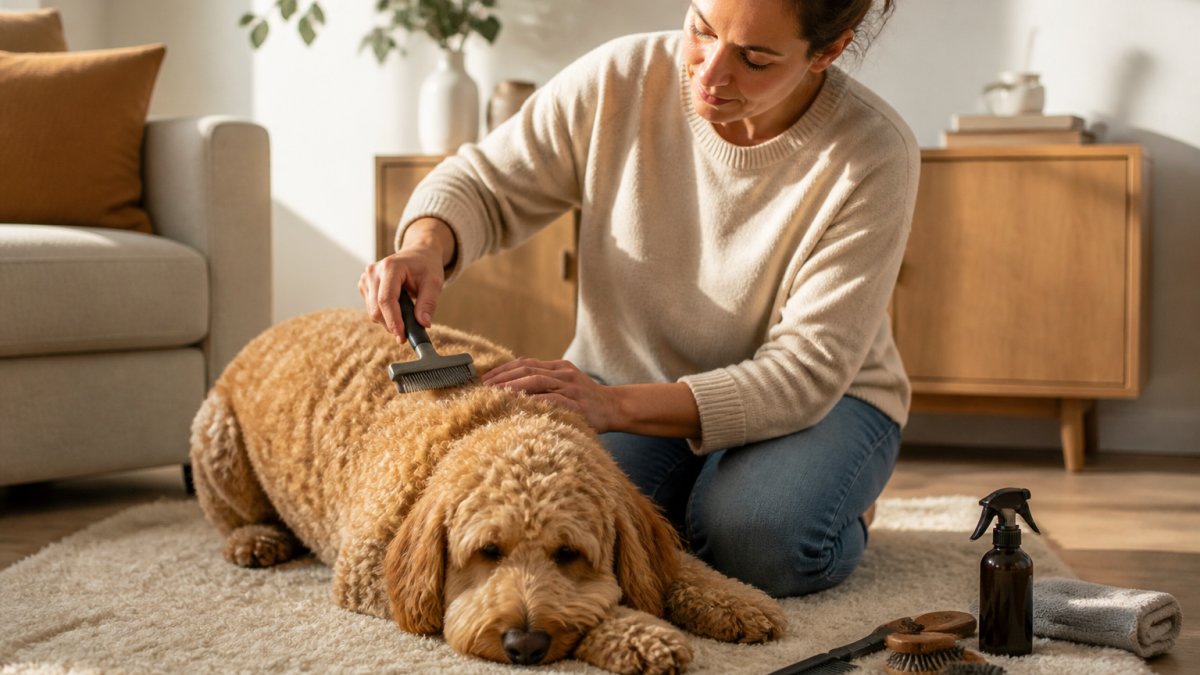
In practice, this means ten minutes rather than forty. It means a towel or rug so paws are not sliding on floorboards. And it means watching for the early signals: lip licking, turning the head away, a lifted paw, a stiffened body.
A few habits that make a genuine difference:
- Brush after a walk, when your dog is already tired
- Keep one hand resting gently on the body to steady rather than restrain
- Reward calm behaviour with a treat, not with a break from brushing
- Split the coat into zones and do one zone per session if needed
- Never chase a dog who has walked away
For puppies new to all of this, our Gentle Puppy Grooming Confidence Guide walks through handling practice for paws, ears, and face, plus a printable checklist.
Dog Nail Clippers and Grinders: A Gentle Approach
Nail clippers suit most dogs, while grinders suit dogs who tolerate noise and vibration but dislike the sudden pressure of a clip. Both work. The right choice depends on your dog's temperament and how confident you feel holding each paw.
Clippers remove length quickly, which makes them efficient for a dog with long, neglected nails. The risk is cutting into the quick, the blood supply inside the nail, which is painful and makes a dog hand-shy fast. Grinders take longer but remove small amounts at a time, so the margin for error is wider.
Whichever you choose, the technique matters more than the tool:
Pride + Groom The Luxe Gift Set – Premium Dog Grooming Collection →
- Handle paws daily for a week before you cut anything, with no clippers in sight
- Take tiny amounts and check the nail face after each pass
- Clip at an angle following the natural curve of the nail
- Keep styptic powder on hand in case you catch the quick
- Do one paw per session if your dog is anxious, and build up
If your dog's nails are dark, you cannot see the quick, so go slowly and stop while the cut face still shows a pale centre. If nails are severely overgrown or curling into the pad, ask a groomer or vet to take the first pass.
Bath Time Tools: Shampoos, Brushes and Drying Towels
Bath time tools should do three jobs: clean without stripping the coat, work the lather down to the skin, and dry the dog thoroughly. Skipping the drying step is where most home baths go wrong, because a damp curly coat left to air dry will mat as it settles.
Start with the shampoo. A curly or non-shedding coat benefits from a formula built for that hair type. THE NON SHEDDER shampoo is formulated for Poodles, Cockapoos, Goldendoodles, and other curly-coated breeds, with a hydrating, detangling finish and a formula that rinses out cleanly. For puppies or dogs with sensitive skin, THE SENSITIVE ONE uses hemp oil, aloe, and oatmeal, and is gentle enough for puppies of all ages.
Next, a bath brush. A silicone brush works the shampoo down through the coat far better than fingers alone. The Bath Brush has soft silicone bristles that massage and lift loose fur while lathering, and it rinses clean in seconds. If you want options for different coat types, The Bath Brush Set bundles brushes matched to shedding, non-shedding, and sensitive coats.


Then drying. This is the step people rush. THE TOWEL microfibre drying towel soaks up water up to seven times its own weight and has hand pockets so you can hold the dog securely while you work. It is odour and bacteria resistant, which matters between washes, and it suits all coat types.
| Tool | Job | Best For | Watch Out For |
|---|---|---|---|
| Coat-matched shampoo | Cleans without stripping | Curly, sensitive, or puppy coats | Using human shampoo |
| Silicone bath brush | Works lather to the skin | All coat types | Pressing too hard on bony areas |
| Microfibre drying towel | Removes water fast | Post-bath, wet walks | Leaving the coat damp |
| Detangling spray | Reduces friction | Tangle-prone coats | Spraying directly into eyes |
If you would rather buy the whole bath routine in one go, the Pride + Groom Luxe Gift Set collects the hero grooming products for shedding, non-shedding, or sensitive coat types in gift packaging, which also makes it an easy present for a new doodle owner.

Keeping Your Dog Grooming Tools Clean and Ready
Clean tools work better and last longer, and a dirty brush can spread skin irritation from one part of the coat to another. The routine takes minutes and is worth building into your weekly groom.
- Slicker brushes: pull loose fur from the bristles after every session, and wash the head in warm soapy water monthly
- Metal combs: wipe with a cloth and check for bent teeth that can scratch
- Nail clippers: wipe the blades and store them dry to prevent rust
- Grinders: empty the dust chamber after each use and check the bit for wear
- Bath brushes: rinse and air dry standing upright so water drains away
- Towels: wash regularly, since damp microfibre holds odour
Store everything in one tray or pouch. A single kit you can lift out and put back means you are far more likely to do a five-minute brush than if you are hunting through cupboards. Replace slicker brush heads when the wires have bent outward and no longer reach the skin, and replace clipper blades when they start pulling rather than cutting.
Conclusion
The honest challenge with home grooming is not the shopping list. It is building a routine calm enough that your dog tolerates it and you keep it up. Most owners start with good intentions, buy too much, and then stop after a difficult bath day.
That is where we can help. Dexter And Billy Co exists to make at-home care feel manageable rather than overwhelming, with practical digital guides and printable workbooks built around calm, short routines. The Calm Dog Grooming & Coat Care Guide covers coat types, tool selection, bath preparation, and when to call a professional, while the Gentle Puppy Grooming Confidence Guide helps you start handling and nail care early, before fear sets in.
Get started with Dexter And Billy Co and give your dog a grooming routine that feels predictable, gentle, and genuinely yours.
Frequently Asked Questions
What grooming tools do I need to groom my dog at home?
A basic home kit includes a slicker brush, a metal comb, nail clippers or a grinder, a gentle dog shampoo, and a quick-drying towel. For curly coats, add a detangling spray like THE LEAVE IN and use a slicker brush designed for tangle-prone fur. You do not need every professional tool. Start with these dog grooming tools for beginners and add more as your confidence grows.
What is the difference between a slicker brush and a pin brush?
A slicker brush has fine, angled wire pins that reach into the coat to remove loose fur and small tangles. A pin brush has longer, rounded pins and is better for longer, silkier coats. For curly or doodle coats, a slicker brush is usually the better starting point because it separates curls without pulling. Many groomers use both, starting with the slicker and finishing with a comb.
Which comb is best for a dog with a curly or tangle-prone coat?
A metal greyhound comb with wide and narrow teeth is the go-to choice. Use the wide teeth first to find tangles, then the narrow teeth to check the coat all the way to the skin. This dog grooming brush for curly coats combination, a slicker plus a comb, helps you catch mats early. Work in small sections and never pull through a knot.
Do dog groomers use clippers or scissors?
Both. Clippers do the bulk of the work on body coats, while scissors shape faces, feet and tidy-up areas. For everyday owners, clippers are the more useful first purchase if you plan to trim between professional appointments. Scissors need a steady hand, so many owners leave detailed scissor work to a groomer and focus on brushing, bathing and nail care at home.
How often should I brush my dog's coat?
Most dogs benefit from a quick brush three to four times a week, and curly or tangle-prone coats need daily attention in the areas that mat most, such as behind the ears, under the collar and around the legs. A five-minute session is often enough. Regular, short brushing is far kinder than a long detangling session after mats have formed.